
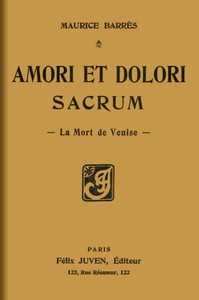
Amori et dolori sacrum: La mort de Venise by Maurice Barrès
Published in 1903, Maurice Barrès's 'Amori et dolori sacrum: La mort de Venise' (Sacred to Love and Sorrow: The Death of Venice) is a lyrical, impressionistic work that sits somewhere between a novella, a travel diary, and a philosophical meditation. It's a portrait of a city seen through a veil of personal obsession and poetic despair.
The Story
The story is simple on the surface. A French writer, much like Barrès himself, travels to Venice seeking artistic renewal. Instead of finding inspiration, he becomes consumed by the city's atmosphere of glorious decay. Venice isn't just old to him; it's actively dying, and its beauty is part of the sickness. He wanders through silent canals and crumbling palaces, feeling the weight of centuries. His experience crystallizes around a mysterious, unnamed Venetian woman he encounters. She isn't a romantic interest in a conventional sense. She represents Venice itself—fragile, proud, and fading. Their interactions are charged with a silent understanding of shared melancholy. The 'plot' is the narrator's deepening immersion into this state of mind, where love for the city's art and history is inseparable from the sorrow of watching it slip away.
Why You Should Read It
Don't pick this up for a fast-paced adventure. Read it for the atmosphere. Barrès pours his soul into describing Venice's light, its water, its stones. He makes you feel the damp chill of a palace and the eerie silence of a empty piazza at dawn. His central idea—that a place can be so beautiful it becomes a monument to its own end—is fascinating and deeply sad. The book is a love letter and a eulogy written at the same time. It’s about how we can be passionately attached to things that are disappearing, and how that very imperfection makes them more precious. The unnamed woman is a brilliant device; she’s not a full character but a ghostly symbol, making the city's fate feel heartbreakingly personal.
Final Verdict
This book is perfect for readers who love mood over action, and for anyone who has ever traveled somewhere and felt its history press down on them. It's for lovers of poetic prose, decaying grandeur, and complex emotions. If you enjoyed the melancholic wanderings in W.G. Sebald's work or the atmospheric pressure of some of Poe's tales, you'll find a kindred spirit in Barrès. It’s a short, intense dose of fin-de-siècle gloom and beauty. Just be warned: it might ruin cheerful, sunny travelogues for you forever. After this, Venice will always seem a little ghostly.
You are viewing a work that belongs to the global public domain. Share knowledge freely with the world.
Ava Wright
3 weeks agoI was skeptical at first, but the flow of the text seems very fluid. Don't hesitate to start reading.
Kimberly Walker
10 months agoI came across this while browsing and the character development leaves a lasting impact. Exactly what I needed.





Steven Moore
1 year agoBeautifully written.