
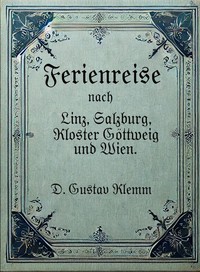
Ferienreise nach Linz, Salzburg, Kloster Göttweig und Wien by Klemm
Gustav Klemm's travelogue is a direct line to the summer of 1839. The book follows his real journey from his home in Dresden, through the Austrian heartland. This isn't a plotted novel, but the narrative comes from his keen observations and the people he meets.
The Story
Klemm boards a stagecoach and later one of the newfangled steamships on the Danube. His trip is a series of vivid snapshots. In Linz, he's fascinated by the factories and the buzz of early industry. In Salzburg, he's the classic tourist, hunting for Mozart's spirit around every corner. His visit to Kloster Göttweig is quieter, full of awe for the art and the peaceful rhythm of monastic life. Finally, in Vienna, he's overwhelmed by the scale and sophistication of the imperial capital. The 'story' is his attempt to make sense of it all. He talks to farmers, scholars, and priests. He argues about the future of Germany, gets excited about railways, and complains about bad wine. The journey is his search for what holds these places together in a time of massive change.
Why You Should Read It
I loved this because Klemm feels like a real person, not a stuffy historian. His curiosity is contagious. One minute he's describing the engineering of a bridge, and the next he's recounting a hilarious story about a stubborn innkeeper. You get the grand sights, but also the gritty reality of travel—the bumpy roads, the questionable food, the struggle to find a good guide. His voice is honest and sometimes conflicted. He loves the beautiful old traditions but can't help being drawn to the promise of progress. Reading this book is the closest you'll get to time travel without a machine. It removes the glass case from history and lets you walk through it with a chatty, opinionated companion.
Final Verdict
This book is a hidden gem for a specific reader. It's perfect for history lovers who want to feel the past, not just memorize dates. If you enjoy travel writing, this is its great-great-grandfather, full of the same wonder and frustration any traveler knows. It's also ideal for anyone interested in 19th-century Europe and the birth of the modern world, seen from a carriage window. A word of caution: it's a product of its time, so some viewpoints are dated. But if you approach it as a conversation with a man from 1839, it's a completely captivating and unique read.
This historical work is free of copyright protections. It serves as a testament to our shared literary heritage.
Nancy Hill
9 months agoVery helpful, thanks.
Oliver Rodriguez
1 year agoClear and concise.
Noah Hill
1 year agoHigh quality edition, very readable.
Aiden Nguyen
1 year agoI have to admit, the content flows smoothly from one chapter to the next. Exceeded all my expectations.


Richard Thomas
1 year agoWow.